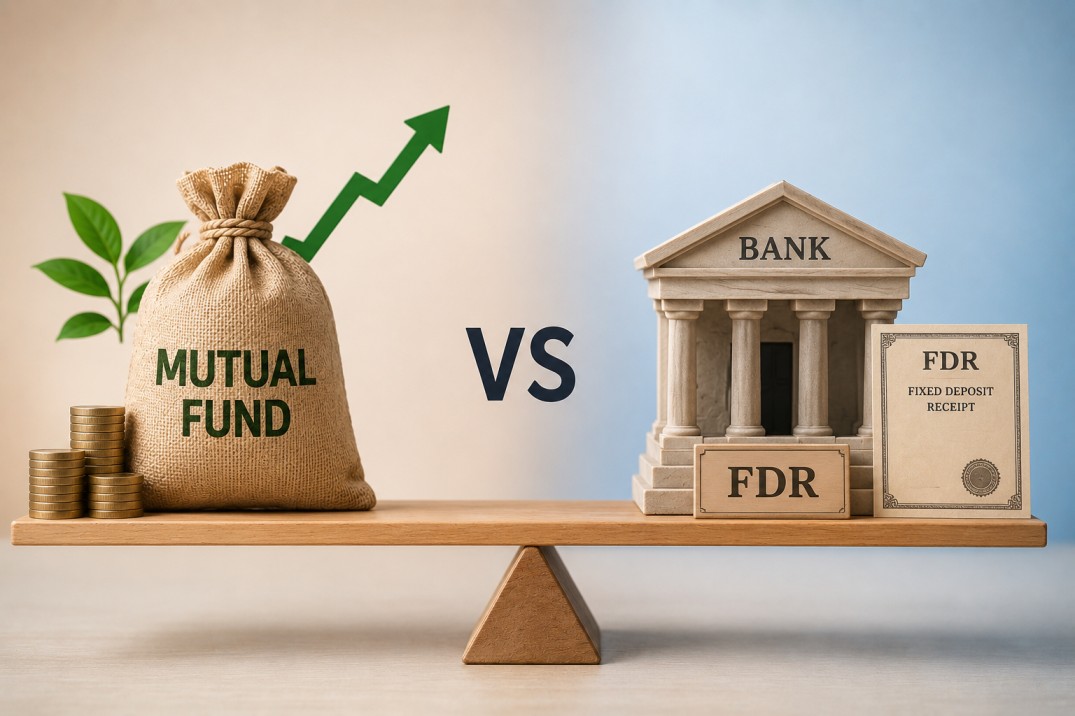
If you're wondering whether to invest in mutual funds or bank Fixed Deposit Receipts (FDR) in Bangladesh, the answer depends on your investment goals, risk tolerance, and time horizon. For higher returns and long-term wealth creation, mutual funds are better (8-18% returns). For safety and guaranteed returns, bank FDR is better (6-10% returns). BSEC Chairman has confirmed that mutual funds are much more profitable than bank fixed deposits, with mutual funds capable of giving 10-18% dividends while bank deposits offer only 5-6%.
This comprehensive guide provides detailed comparison, real return calculations, tax benefits, and expert recommendations to help you make the right investment decision in Bangladesh's 2026 market.
What Is Bank FDR (Fixed Deposit Receipt) in Bangladesh?
Bank FDR, or Fixed Deposit Receipt (বাংলায়: মেয়াদী আমানত), is a banking product where you deposit money in a bank for a fixed period (typically 3 months to 10 years) and receive predetermined interest rate returns.
Key Features of Bank FDR:
Guaranteed Returns:
- Fixed interest rate known at the time of investment
- No market risk - returns are guaranteed by bank
- Predictable income stream
Interest Rates in 2026:
- 3-month FDR: 9.50% interest rate
- 6-month FDR: 9.75% interest rate
- General range: 6% to 10% for most banks
- Some special schemes offer higher rates
Investment Period:
- Minimum: 3 months
- Maximum: 10 years
- Common options: 6 months, 1 year, 2 years, 5 years
Safety Level:
- Very low risk
- Bank-deposited money insured up to certain limit
- Government-regulated banking system
Tax Treatment:
- 10% AIT (Advance Income Tax) charged on interest income
- Tax rebate up to BDT 18,000 maximum (for DPS up to BDT 120,000)
- Interest income falls under taxable purview
What Is Mutual Fund in Bangladesh?
A mutual fund is a pooled investment vehicle where money from multiple investors is combined and invested in stocks, bonds, treasury securities, or other assets by professional fund managers.
Key Features of Mutual Funds:
Returns:
- Not guaranteed - depends on market performance
- Equity funds: 10-18% annual returns potential
- Debt/fixed-income funds: 8-10% annual returns
- SIP in mutual funds gives much higher returns than bank FD
- BSEC Chairman confirmed mutual funds can give 10-18% dividend
Risk Level:
- Equity funds: Moderate to high risk
- Debt funds: Low to moderate risk
- Balanced funds: Moderate risk
- Market-dependent returns
Investment Flexibility:
- No fixed period - open-ended funds allow anytime redemption
- SIP options for regular monthly investing
- Minimum investment: BDT 1,000-5,000 typically
Liquidity:
- High liquidity for open-ended funds
- Can liquidate assets in 3-5 business days
- No penalty on early withdrawal (unlike bank FDR)
Tax Benefits:
- Tax rebate up to BDT 75,000 for debt funds (15% of investment up to BDT 500,000)
- Tax rebate up to BDT 500,000 for equity funds (15% of investment up to BDT 5,000,000)
- 4 times higher tax rebate than bank DPS
- Mutual fund income does not fall under tax purview at fund level
Mutual Fund vs Bank FDR: Complete Comparison
1. Returns Comparison
Bank FDR Returns:
- Fixed return: 6% to 10% annually
- 3-month FDR: 9.50%
- 6-month FDR: 9.75%
- General range: 6-10%
- Fixed and guaranteed
Mutual Fund Returns:
- Variable return: 8% to 18% annually
- Equity funds: 10-12% typical, up to 18% potential
- Debt funds: 8-10% typical
- SIP mutual funds give much higher returns than bank FD
- BSEC confirmed: 10-18% dividend capacity
- Can be high or low depending on market trends
Winner for Returns: Mutual Fund (10-18% vs 6-10%)
2. Risk Comparison
Bank FDR Risk:
- Low risk (safe investment)
- Guaranteed returns with no market exposure
- Bank failure risk minimal (government-regulated)
- Principal protection guaranteed
Mutual Fund Risk:
- Moderate to high risk for equity funds (market dependent)
- Low to moderate risk for debt funds
- Market-dependent returns
- No guaranteed returns
- NAV fluctuation possible
Winner for Safety: Bank FDR (guaranteed, low risk)
3. Liquidity Comparison
Bank FDR Liquidity:
- Can withdraw early but with penalty
- Premature liquidation: bank may not give promised return
- Lock-in period applies
- Limited flexibility
Mutual Fund Liquidity:
- Can sell anytime for open-ended funds
- Liquidate assets in 3-5 business days
- No penalty on early withdrawal
- High liquidity
- Flexible redemption
Winner for Liquidity: Mutual Fund (no penalty, faster access)
4. Tax Benefits Comparison
Bank FDR Tax Benefits:
- 10% AIT charged on interest income
- Tax rebate up to BDT 18,000 maximum (for DPS investment up to BDT 120,000)
- Interest income taxable
- No tax advantage at fund level
Mutual Fund Tax Benefits:
- Tax rebate up to BDT 75,000 for debt funds (15% of BDT 500,000 investment)
- Tax rebate up to BDT 500,000 for equity funds (15% of BDT 5,000,000 investment)
- 4 times higher tax rebate than bank DPS
- Income does not fall under tax purview at fund level
- Direct and indirect tax advantages for Treasury bill/bond investments
Winner for Tax Benefits: Mutual Fund (up to 500,000 vs 18,000 BDT)
5. Investment Period Comparison
Bank FDR Period:
- Fixed period: 3 months to 10 years
- Common: 6 months, 1 year, 2 years, 5 years
- Must complete full period for promised return
- Early withdrawal reduces returns
Mutual Fund Period:
- No fixed period for open-ended funds
- SIP: flexible monthly investment
- Long-term recommended: 5+ years for equity funds
- Short-term suitable: 1-3 years for debt funds
- Redemption anytime without lock-in
Winner for Flexibility: Mutual Fund (no lock-in, flexible)
6. Minimum Investment Comparison
Bank FDR Minimum:
- Typically BDT 5,000-10,000 minimum
- DPS: BDT 500-1,000 monthly
- Higher amounts for better rates
Mutual Fund Minimum:
- Lump sum: BDT 1,000 typically
- SIP: BDT 5,000 monthly for individuals
- More accessible for retail investors
- Lower entry barrier
Winner for Accessibility: Mutual Fund (lower minimum)
7. Professional Management Comparison
Bank FDR Management:
- No professional management
- Self-managed investment
- Passive income only
- No active strategy
Mutual Fund Management:
- Professional fund managers with expertise
- Active portfolio management
- Research-driven investment decisions
- Diversified holdings
- Risk management by experts
Winner for Management: Mutual Fund (professional expertise)
8. Diversification Comparison
Bank FDR Diversification:
- No diversification
- Single investment in bank
- Concentration risk
- Fixed income only
Mutual Fund Diversification:
- High diversification across sectors
- Multiple stocks, bonds, securities
- Reduced concentration risk
- Portfolio spread across telecommunications, pharmaceuticals, financial services, energy
- Balanced risk through diversification
Winner for Diversification: Mutual Fund (highly diversified)
9. Return Potential Over Time Comparison
Bank FDR Long-term:
- Fixed 6-10% annually
- Compound interest possible
- Predictable but limited growth
- Inflation may erode real returns
Mutual Fund Long-term:
- 10-18% annual potential for equity
- Compounding through NAV growth
- Higher growth potential
- Can beat inflation significantly
- SIP maximizes compounding benefit
Winner for Long-term Growth: Mutual Fund (higher potential)
10. Inflation Protection Comparison
Bank FDR Inflation Protection:
- 6-10% returns vs 6-7% Bangladesh inflation
- Real return: 0-4% after inflation
- May not fully protect against inflation
- Limited growth potential
Mutual Fund Inflation Protection:
- 10-18% returns vs 6-7% inflation
- Real return: 4-12% after inflation
- Significantly beats inflation
- Better wealth preservation
Winner for Inflation Protection: Mutual Fund (beats inflation better)
Real Return Calculation: 100,000 BDT Investment Over 5 Years
Bank FDR Calculation (9% annual rate):
Principal: BDT 100,000
Annual Interest: 9%
5-Year Compound Return:
- Year 1: 100,000 × 1.09 = 109,000
- Year 2: 109,000 × 1.09 = 118,810
- Year 3: 118,810 × 1.09 = 129,503
- Year 4: 129,503 × 1.09 = 141,158
- Year 5: 141,158 × 1.09 = 153,862
Total Return After 5 Years: BDT 153,862
Profit: BDT 53,862
Annual Return: 9% guaranteed
After Tax (10% AIT):
- Annual tax: 10% of interest = 10% of 9,000 = BDT 900 per year
- 5-year tax: BDT 4,500
- Net Return After Tax: BDT 149,362
Mutual Fund Calculation (12% annual average for equity fund):
Principal: BDT 100,000
Annual Return: 12% (average equity fund return)
5-Year Compound Return:
- Year 1: 100,000 × 1.12 = 112,000
- Year 2: 112,000 × 1.12 = 125,440
- Year 3: 125,440 × 1.12 = 140,493
- Year 4: 140,493 × 1.12 = 157,352
- Year 5: 157,352 × 1.12 = 176,234
Total Return After 5 Years: BDT 176,234
Profit: BDT 76,234
Annual Return: 12% (not guaranteed, market-dependent)
Tax Benefit:
- Tax rebate: 15% of 100,000 = BDT 15,000 (equity fund up to 500,000 limit)
- Net Return After Tax Benefit: BDT 191,234 (including tax rebate)
Comparison Result:
Bank FDR Net Return: BDT 149,362 (after 10% AIT)
Mutual Fund Net Return: BDT 191,234 (including tax rebate)
Difference: BDT 41,872 more with mutual fund
Mutual Fund Advantage: 28% higher returns
Winner: Mutual Fund (28% higher returns with tax benefits)
SIP in Mutual Fund vs Bank DPS: Which Is Better?
SIP in Mutual Fund Benefits:
Higher Returns:
- SIP in mutual funds gives much higher returns than bank FD
- Average return: 12% annually vs DPS 8-9%
- Compounding through regular investing
Market Timing Advantage:
- When market is low, buy more units
- When market is high, buy fewer units
- Average cost benefit
- Takes advantage of market volatility
Tax Benefits:
- Tax rebate up to BDT 75,000 for debt SIP
- Tax rebate up to BDT 500,000 for equity SIP
- 4 times higher than bank DPS
Discipline:
- Creates investment discipline
- Regular monthly savings habit
- Financial goal fulfillment
- Reduces timing risk
Flexibility:
- Can withdraw anytime without penalty
- No lock-in period
- Flexible investment amounts
Bank DPS Benefits:
Guaranteed Returns:
- Fixed 8-9% annually
- No market risk
- Predictable income
Safety:
- Low risk investment
- Bank-deposited money secure
Simplicity:
- Easy to understand
- Simple process
Comparison Result:
- SIP Mutual Fund: 12% returns + higher tax rebate + flexibility
- Bank DPS: 8-9% returns + lower tax rebate + lock-in
Winner: SIP in Mutual Fund (higher returns, better tax benefits, flexibility)
When Should You Choose Bank FDR?
Choose Bank FDR if:
1. You Need Guaranteed Returns
- Fixed income is essential
- No tolerance for return variability
- Predictable cash flow required
2. You Have Very Low Risk Tolerance
- Cannot accept any market risk
- Prefer safety over higher returns
- Conservative investor profile
3. Short-Term Investment (Less Than 3 Years)
- Need money within 1-3 years
- Short-term financial goal
- Emergency fund building
4. You're Retired or Near Retirement
- Need stable income
- Cannot afford capital loss
- Preserve principal
5. You Don't Want Professional Management
- Prefer passive investment
- No interest in market monitoring
- Simple investment structure
6. Emergency Fund
- Need immediate access to cash
- Safety priority over returns
- Liquidity with guarantee
When Should You Choose Mutual Fund?
Choose Mutual Fund if:
1. You Want Higher Returns
- Seek 10-18% annual returns vs 6-10% FDR
- Long-term wealth creation goal
- Can accept market variability
2. You Have Moderate to High Risk Tolerance
- Comfortable with market fluctuations
- Understand investment risk
- Long-term investment horizon
3. Long-Term Investment (5+ Years)
- Building wealth for future
- Child education, retirement planning
- Can ride through market volatility
4. You Want Tax Benefits
- Maximize tax rebate up to BDT 500,000
- Reduce tax liability legally
- Tax-efficient investing
5. You Want Professional Management
- Prefer expert fund managers
- Don't want to pick individual stocks
- Want diversified portfolio
6. You Want Liquidity Without Penalty
- Need flexibility to redeem anytime
- No lock-in period preference
- Quick access to money
7. You Want to Beat Inflation
- 10-18% returns vs 6-7% inflation
- Real wealth preservation
- Growth above inflation
Expert Recommendations and Official Statements
Analyst Recommendations:
Analysts believe open-ended mutual funds will be better investment tool than bank deposits
Reasons:
- Rising interest rates favor fixed-income mutual funds
- Floor price frustrating investors over equity investments
- Open-ended funds are highly liquid
- Can liquidate in 3-5 business days vs bank deposit premature liquidation penalty
Expert Investment Tips for Middle Class:
For balanced approach:
- Invest in both bank FD and mutual funds
- Bank FD for security
- Mutual funds for long-term growth
- Balanced mix achieves both safety and growth
SIP Recommendation:
- Start SIP in mutual fund for monthly investing
- Reduces risk and gets good long-term returns
- Maintain liquid fund for emergency access
Risk Factors Comparison
Bank FDR Risk Factors:
Low Risk:
-Fixed returns guaranteed
- Principal protected
- Bank failure risk minimal
- Government-regulated
Limitations:
- Lower returns may not beat inflation
- 10% AIT on interest reduces net returns
- Lock-in period for promised return
- Limited growth potential
Mutual Fund Risk Factors:
Market Risk:
- Returns not guaranteed
- NAV fluctuation possible
- Market-dependent performance
- Equity funds: moderate to high risk
Risk Management:
- Debt funds: low to moderate risk
- Diversification reduces single-stock risk
- Professional fund management
- Can choose fund based on risk tolerance
Mitigation Strategies:
- Invest in debt funds for lower risk
- Use SIP to average costs
- Long-term investing reduces volatility risk
- Diversify across fund types
Tax Efficiency Deep Comparison
Bank FDR Tax Treatment:
Tax Charged:
- 10% AIT (Advance Income Tax) on interest income
- Interest income falls under taxable purview
- No tax advantage at account level
Tax Rebate:
- Maximum BDT 18,000 (for DPS investment up to BDT 120,000)
- 15% of investment amount
- Limited rebate ceiling
Example:
- FDR interest: BDT 9,000 (9% of 100,000)
- AIT deducted: BDT 900 (10%)
- Net interest: BDT 8,100
- Tax rebate: BDT 18,000 maximum (if qualifies)
Mutual Fund Tax Treatment:
Tax Benefits:
- No tax at fund level
- Income does not fall under tax purview at fund level
- Direct and indirect tax advantages
Tax Rebate:
- Debt funds: up to BDT 75,000 (15% of BDT 500,000 investment)
- Equity funds: up to BDT 500,000 (15% of BDT 5,000,000 investment)
- 4 times higher than bank DPS
Example (Equity Fund):
- Investment: BDT 100,000
- Tax rebate: BDT 15,000 (15%)
- Returns: BDT 12,000 (12%)
- No tax on returns at fund level
- Total benefit: 12% return + 15% tax rebate = 27% effective benefit
Winner: Mutual Fund (significantly better tax efficiency)
Liquidity Deep Comparison
Bank FDR Liquidity:
Early Withdrawal:
- Can withdraw early but with penalty
- Bank may not give promised return on premature liquidation
- Reduced interest rate for incomplete period
- Lock-in period applies
Processing Time:
- 1-3 business days typically
- Bank approval required
- Formalities involved
Mutual Fund Liquidity:
Redemption:
- Can sell anytime for open-ended funds
- No penalty on early withdrawal
- No lock-in period
Processing Time:
- Can liquidate assets in 3-5 business days
- Faster than bank premature withdrawal
- NAV-based redemption
Flexibility:
- Partial redemption allowed
- Full or partial exit
- Flexible timing
Winner: Mutual Fund (no penalty, faster, more flexible)
Best Investment Strategy: Balanced Approach
Recommended Portfolio Allocation:
Conservative Investors (Low Risk):
- 70% Bank FDR (safety)
- 30% Debt Mutual Fund (higher returns + tax benefits)
- Expected return: 7-9% annually
Moderate Investors (Medium Risk):
- 50% Bank FDR (safety)
- 50% Balanced Mutual Fund (growth + income)
- Expected return: 9-12% annually
Aggressive Investors (High Risk):
- 20% Bank FDR (emergency fund)
- 80% Equity Mutual Fund (maximum growth)
- Expected return: 12-18% annually
Salaried Middle Class Recommended:
- Invest in both FD and mutual funds
- FD for security and short-term needs
- Mutual funds for long-term wealth
- Start SIP for disciplined monthly investing
- Maintain liquid fund for emergency
Common Mistakes to Avoid
Mistake 1: Choosing Only Bank FDR for Long-Term
Problem:
- 6-10% returns may not beat inflation significantly
- Limited wealth creation
- Tax inefficient (10% AIT)
Solution:
- Allocate portion to mutual funds for long-term
- 10-18% potential returns beat inflation better
- Better tax benefits
Mistake 2: Choosing Only Mutual Fund for Short-Term
Problem:
- Market risk for short-term goals
- Return variability
- NAV fluctuation possible
Solution:
- Use bank FDR for short-term (less than 3 years)
- Use mutual fund for long-term (5+ years)
- Balanced approach for different time horizons
Mistake 3: Ignoring Tax Benefits
Problem:
- Missing BDT 75,000-500,000 rebate potential
- Reducing net returns unnecessarily
- Not optimizing tax efficiency
Solution:
- Consider tax rebate in investment decision
- Mutual funds offer 4x higher rebate than bank DPS
- Maximize tax-efficient investing
Mistake 4: Not Considering Liquidity Needs
Problem:
- Bank FDR lock-in penalty
- Emergency fund not accessible
- Inflexible investment structure
Solution:
- Maintain liquid portion in bank FDR/savings
- Invest long-term portion in mutual funds
- Flexible redemption options
Mistake 5: Not Using SIP for Regular Investing
Problem:
- Missing compounding benefits
- Timing risk
- No investment discipline
Solution:
- Start SIP in mutual fund
- Regular monthly investing reduces risk
- Maximizes compounding returns
Frequently Asked Questions (FAQ)
Q1: Which gives higher returns - mutual fund or bank FDR?
Mutual funds give higher returns. Mutual funds can provide 10-18% annual returns while bank FDR offers only 6-10%. BSEC Chairman confirmed mutual funds are much more profitable than bank fixed deposits.
Q2: Is mutual fund safer than bank FDR?
Bank FDR is safer. Bank FDR offers guaranteed returns with low risk, while mutual fund returns are market-dependent with moderate to high risk for equity funds. Choose bank FDR for safety, mutual fund for higher returns.
Q3: What is the return difference between mutual fund and bank FDR?
Mutual fund: 10-18% annual returns (equity), 8-10% (debt)
Bank FDR: 6-10% annual returns
Difference: 2-12% higher returns with mutual funds
Q4: Which is better for tax benefits - mutual fund or bank FDR?
Mutual funds offer significantly better tax benefits. Tax rebate up to BDT 500,000 for equity mutual funds vs only BDT 18,000 for bank DPS. That's 4 times higher tax rebate.
Q5: Can I withdraw mutual fund investment anytime like bank FDR?
Yes, open-ended mutual funds allow redemption anytime without penalty. Bank FDR has lock-in period and early withdrawal penalty. Mutual funds are more liquid.
Q6: Which is better for long-term investment - mutual fund or bank FDR?
Mutual fund is better for long-term (5+ years). Higher returns (10-18% vs 6-10%), better inflation protection, and compounding benefits make mutual funds superior for long-term wealth creation.
Q7: Which is better for short-term investment - mutual fund or bank FDR?
Bank FDR is better for short-term (less than 3 years). Guaranteed returns, no market risk, and predictable income make bank FDR suitable for short-term goals.
Q8: What does BSEC say about mutual fund vs bank FDR?
BSEC Chairman stated: "Investment in mutual funds is much more profitable than the fixed deposits in banks. Clients can get 5-6% on bank deposits, but mutual funds have capacity to give 10-18% dividend."
Q9: Is SIP in mutual fund better than bank DPS?
Yes, SIP in mutual fund gives much higher returns than bank FD. SIP offers 12% average returns vs DPS 8-9%, plus 4 times higher tax rebate and flexibility without lock-in.
Q10: What should middle-class salaried people invest - mutual fund or bank FDR?
Invest in both for balanced approach. Bank FD for security and short-term needs, mutual funds for long-term wealth growth. Start SIP for disciplined monthly investing.
Q11: Which beats inflation better - mutual fund or bank FDR?
Mutual fund beats inflation better. 10-18% returns vs 6-7% Bangladesh inflation gives 4-12% real return, while bank FDR's 6-10% gives only 0-4% real return after inflation.
Q12: How much time to liquidate mutual fund vs bank FDR withdrawal?
Mutual fund: 3-5 business days
Bank FDR premature: 1-3 business days with penalty
Mutual fund has faster processing without penalty.
Q13: What is the minimum investment for mutual fund vs bank FDR?
Mutual fund: BDT 1,000 lump sum, BDT 5,000 monthly SIP
Bank FDR: BDT 5,000-10,000 typically
Mutual fund has lower entry barrier.
Q14: Can retired people invest in mutual fund?
Yes, but debt mutual funds are better for retired people. Lower risk (8-10% returns) with regular income through dividends. Bank FDR also suitable for guaranteed income.
Q15: What is the best investment mix for balanced approach?
50% Bank FDR for safety + 50% mutual fund for growth. Conservative: 70% FDR + 30% debt fund. Aggressive: 20% FDR + 80% equity fund.
Final Verdict: Mutual Fund vs Bank FDR
For Higher Returns: MUTUAL FUND WINS
- Returns: 10-18% vs 6-10%
- 28% higher returns in 5-year calculation
- Better long-term wealth creation
- Beats inflation significantly
For Safety and Guaranteed Returns: BANK FDR WINS
- Guaranteed fixed returns
- Low risk investment
- Principal protection
- No market volatility
For Tax Benefits: MUTUAL FUND WINS
- Tax rebate up to BDT 500,000 vs BDT 18,000
- 4 times higher tax rebate
- No tax at fund level
- Better tax efficiency
For Liquidity: MUTUAL FUND WINS
- No penalty on early withdrawal
- 3-5 business days liquidation
- Flexible redemption
- No lock-in period
For Short-Term Goals: BANK FDR WINS
- Guaranteed returns for less than 3 years
- No market risk
- Predictable income
- Safety priority
For Long-Term Goals: MUTUAL FUND WINS
- Higher returns for 5+ years
- Compounding benefits
- Inflation protection
- Wealth creation
The Bottom Line Recommendation
Choose Bank FDR if:
- You need guaranteed returns
- Very low risk tolerance
- Short-term investment (less than 3 years)
- Retired or near retirement
- Emergency fund building
Choose Mutual Fund if:
- You want higher returns (10-18%)
- Moderate to high risk tolerance
- Long-term investment (5+ years)
- Want maximum tax benefits
- Need liquidity without penalty
- Want to beat inflation
Best Strategy: BALANCED APPROACH
- Invest in BOTH for different purposes
- Bank FDR for safety and short-term needs
- Mutual Fund for long-term growth and wealth creation
- 50% FDR + 50% Mutual Fund for moderate investors
- Start SIP for disciplined monthly investing
For most Bangladesh investors in 2026:
Mutual funds are the better choice for long-term wealth creation, offering significantly higher returns (10-18% vs 6-10%), better tax benefits (up to BDT 500,000 vs BDT 18,000), and superior liquidity. However, maintain portion in bank FDR for safety and emergency needs.
Official BSEC Confirmation: Investment in mutual funds is much more profitable than bank fixed deposits, with mutual funds capable of giving 10-18% dividend while bank deposits offer only 5-6%.
Start your investment journey today with proper diversification between bank FDR and mutual funds based on your goals, risk tolerance, and time horizon. For mutual fund investment guidance and latest NAV updates, follow biniyog.com.bd - your trusted partner in smart investing in Bangladesh.