If you want to invest in mutual funds in Bangladesh, understanding the difference between open-ended and closed-ended mutual funds is the most important first step. This guide explains everything you need to know about both types, their advantages, disadvantages, and which one suits your investment goals best.
What Is a Mutual Fund?
A mutual fund is a pooled investment vehicle where money from multiple investors is combined and invested in stocks, bonds, or other securities by a professional fund manager. In Bangladesh, mutual funds are regulated by the Bangladesh Securities and Exchange Commission (BSEC) and offer investors a way to diversify their portfolio with lower risk compared to direct stock market investing.
Open-Ended Mutual Fund: Full Definition
An open-ended mutual fund is a fund that continuously issues and redeems units based on investor demand. There is no fixed number of units, and investors can buy or sell units at any time during the fund's lifetime at the current Net Asset Value (NAV) per unit.
Key Characteristics of Open-Ended Mutual Funds
- No fixed maturity date: The fund operates indefinitely
- Continuous issuance and redemption: Investors can buy or sell units anytime
- Liquidity: High liquidity as units can be redeemed on demand
- NAV-based pricing: Units are priced at the current Net Asset Value
- Flexible investment: You can invest any amount at any time
- No fixed unit count: The number of units changes based on subscriptions
How Open-Ended Funds Work in Bangladesh
In Bangladesh's capital market, open-ended (বাংলায়: বে-মেয়াদি) mutual funds allow you to invest through the following process:
- Choose a Fund Management Company (AMC)
- Select your mutual fund scheme
- Open a BO (Beneficiary Owner) account
- Submit your investment application
- Deposit the investment amount
- Receive your unit holdings and monitor performance
- Redeem units when you want to exit
Advantages of Open-Ended Mutual Funds
- Maximum liquidity: You can exit anytime by redeeming units
- Flexibility: Invest whenever you have money, any amount
- No pressure to hold until maturity: Exit when you're ready
- Regular NAV updates: Know your investment value daily
- Suitable for long-term investing: Perfect for goal-based planning
- Lower entry barrier: Start with smaller amounts
Disadvantages of Open-Ended Mutual Funds
- No guaranteed return: Returns depend on market performance
- NAV volatility: Unit price changes with market conditions
- Potential for early exit: Some investors may redeem prematurely, affecting fund stability
- Management fees: Annual fund management charges apply
Closed-Ended Mutual Fund: Full Definition
A closed-ended mutual fund has a fixed number of units issued at the start, with a specific maturity date. Investors can buy units during the initial offering period but cannot redeem them directly with the fund until maturity. After the initial offering, units trade on the stock exchange like shares.
Key Characteristics of Closed-Ended Mutual Funds
- Fixed number of units: No new units created after initial offering
- Fixed maturity date: Fund closes and distributes assets at maturity
- Limited liquidity: Units trade on stock exchange, not redeemed with fund
- Market price pricing: Units trade at market-determined prices (may differ from NAV)
- Defined investment period: Know exactly when fund ends
- Predictable structure: Fund manager knows exact capital amount
How Closed-Ended Funds Work
- Initial Public Offering (IPO): Units sold at fixed price during launch period
- Stock Exchange Listing: Units trade on Dhaka Stock Exchange (DSE) or Chittagong Stock Exchange (CSE)
- Market Trading: Buy/sell units through stock broker like regular shares
- Maturity: At end date, fund liquidates assets and distributes to unit holders
Advantages of Closed-Ended Mutual Funds
- Fixed capital: Fund manager knows exact amount to invest
- No redemption pressure: Manager can invest in longer-term strategies
- Potential discount to NAV: Units may trade below actual NAV
- Defined timeline: Know exactly when investment ends
- Professional management: Same expert management as open-ended funds
- Transparent trading: Market price visible on stock exchange
Disadvantages of Closed-Ended Mutual Funds
- Lower liquidity: Must sell on stock exchange, may face limited buyers
- Price volatility: Market price can deviate significantly from NAV
- No early redemption: Cannot exit directly with fund before maturity
- Locked-in period: Money tied until maturity or able to sell on exchange
- brokerage fees: Pay stock trading brokerage when buying/selling
- Market risk: Subject to stock market sentiment affecting unit price
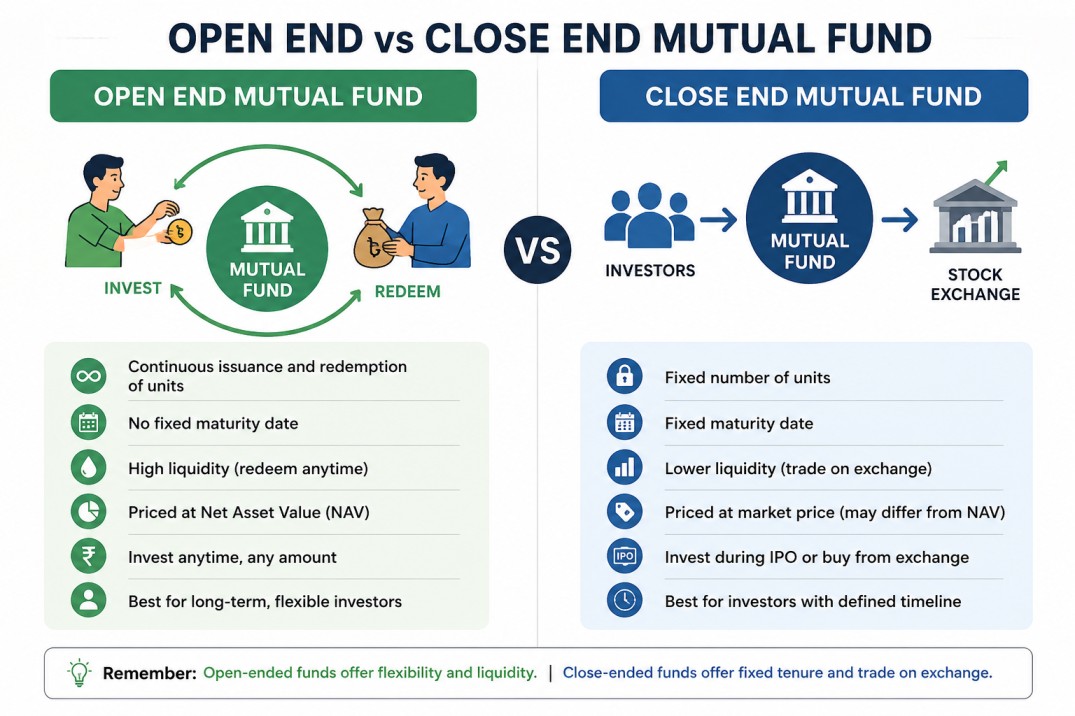
Open-Ended vs Closed-Ended: Key Differences at a Glance
Open-Ended Fund
- Unit Count: Continuous and variable
- Maturity Date: No fixed maturity date
- Liquidity: High (units can be redeemed anytime)
- Pricing: Based on Net Asset Value (NAV)
- Investment Flexibility: Invest anytime and in any amount
- Exit Option: Redeem units directly with the fund
- Fund Stability: Variable capital
- Best For: Long-term investors seeking flexibility and liquidity
Closed-Ended Fund
- Unit Count: Fixed and constant
- Maturity Date: Fixed maturity date
- Liquidity: Lower (units are traded on the stock exchange)
- Pricing: Based on market price, which may differ from NAV
- Investment Flexibility: Invest during IPO or purchase from the stock exchange
- Exit Option: Sell units on the stock exchange
- Fund Stability: Fixed capital
- Best For: Investors with a defined investment horizon and exchange-trading preference
Which Type Should You Choose in Bangladesh?
Choose Open-Ended If:
- You want liquidity to exit anytime
- You plan long-term investment without fixed end date
- You want to invest regularly (SIP style)
- You prefer NAV-based transparent pricing
- You're new to mutual fund investing
Choose Closed-Ended If:
- You have a specific investment timeline
- You understand stock market trading
- You want potential discount to NAV opportunities
- You don't need immediate liquidity
- You're comfortable with market price volatility
Tax Benefits for Mutual Fund Investors in Bangladesh
In Bangladesh, mutual fund investments qualify for tax rebates. You can enjoy a maximum tax rebate of 500,000 taka for investments in mutual funds, unit funds, or debentures. This rebate is calculated as the smallest of: 10 million taka, 3% of total taxable income, or 15% of actual investment.
To claim the rebate:
- Submit income tax return with Form 24D
- Include investment details with proof
- File through National Board of Revenue (NRB) prescribed process
How to Invest in Open-Ended Mutual Funds in Bangladesh
Follow these steps:
- Research mutual fund companies in Bangladesh
- Select a Fund Management Company (AMC)
- Choose your mutual fund scheme (open-ended)
- Open a BO (Beneficiary Owner) account
- Complete investment application
- Deposit investment amount
- Receive unit holdings
- Monitor performance regularly
- Redeem units when needed
Frequently Asked Questions (FAQ)
Q: What is the main difference between open-ended and closed-ended mutual funds?
A: Open-ended funds have no fixed maturity and allow continuous buying/selling at NAV. Closed-ended funds have fixed units, fixed maturity, and trade on stock exchanges.
Q: Can I exit an open-ended mutual fund anytime?
A: Yes, open-ended funds allow you to redeem units at any time during the fund's lifetime at the current NAV.
Q: Where do closed-ended mutual fund units trade in Bangladesh?
A: Closed-ended units trade on Dhaka Stock Exchange (DSE) or Chittagong Stock Exchange (CSE) like regular shares.
Q: Which mutual fund type is better for beginners in Bangladesh?
A: Open-ended funds are generally better for beginners due to higher liquidity, flexibility, and NAV-based transparent pricing.
Q: Do mutual funds in Bangladesh offer tax benefits?
A: Yes, mutual fund investments qualify for tax rebates up to 500,000 taka in Bangladesh.
Q: How are open-ended fund units priced?
A: Open-ended fund units are priced at the current Net Asset Value (NAV) per unit, calculated daily based on fund's underlying assets.
Q: Can closed-ended fund units be redeemed before maturity?
A: No, closed-ended units cannot be redeemed with the fund before maturity. You must sell them on the stock exchange.
Q: What is NAV in mutual funds?
A: NAV (Net Asset Value) is the per-unit value of the fund's assets minus liabilities, calculated daily for open-ended funds.
Start Your Mutual Fund Investment Journey with Biniyog
Biniyog.com.bd is your trusted platform for investment knowledge in Bangladesh. We provide comprehensive guides on mutual funds, stock market investing, tax optimization, and financial planning to help you make smart investment decisions.
Follow biniyog.com.bd for the right investment knowledge, and the right investment knowledge will bring you maximum profit.
Key Takeaways
- Open-ended funds: No maturity date, continuous buying/selling, high liquidity, NAV-based pricing
- Closed-ended funds: Fixed units, fixed maturity, trade on stock exchange, market price pricing
- Open-ended is better for beginners and those needing liquidity
- Closed-ended suits investors with defined timelines who understand stock trading
- Mutual fund investments in Bangladesh offer tax rebates up to 500,000 taka
- Follow proper investment process: choose AMC, open BO account, invest, monitor, redeem
Ready to invest? Start your mutual fund journey today with proper research and planning. Visit biniyog.com.bd for more investment guides and expert advice on mutual funds, stock market, and financial planning in Bangladesh.